A BluesWax Reprint
Sittin’ In With Tom Principato
Guitar Thrills, Blues, and A World of Music
from Tom Principato
Part One
By Bob Margolin
Last year, I wrote a column for our sister print
magazine, Blues Revue, about playing at the Cerdanyola Blues festival
near Barcelona. I’d done an indoor show on a Friday night,
but on the Sunday afternoon, I went down to sit in with Tom Principato’s
band, playing outside in a beautiful park. I am very aware that
the world’s greatest guitar players come from Spain, where
the modern form of the instrument was invented, and that American
Blues guitarists may entertain a Spanish audience, but are not
likely to impress them.
You’ll read below that it’s important to Tom to play
with feeling, but while he always accomplishes that, he displays
chops that leave even the world’s toughest guitar audience
bug-eyed, open-mouthed, and flat-footed – amazed. I knew
that was going to happen, so it was fun to watch. Tom was always
one of the most accomplished guitar players I’ve ever heard.
He can capture the spirit of Blues, Jazz, Rock ’n’
Roll, Swing, Latin, Cajun, Country, Rockabilly, R&B, or standards
as a master rather than as a dilettante. He composes beautiful
songs in all of these styles, and leads his band with authority.
His guitar tones and picking are sensually gorgeous. He dresses
well and projects a friendly vibe as he has fun creating his music
onstage. His singing is strong and he has a warm tone of voice,
but that guitar just burns and commands attention.
And then he calls me up to jam – anything less than my best
will get steamrolled by Tom’s usual, but it’s not
a challenge to be competitive, it’s a call to make our guitars
push and inspire each other and work together. We’ve been
doing that on bandstands together for a long time...
The Blues scene in Boston in the early 1970s was very exciting,
with young Blues players emerging who are well known today. James
Montgomery, originally from Detroit, led a band that packed the
local clubs. One night I went to see him play at the Zircon club
in Somerville, and was disappointed to find that James was only
carrying one guitar player that night instead of two. Larry Carsman
kicked ass, but I missed Tom, the other hot guitar player who’d
been playing with James. Tom returned to Boston from his hometown
of Falls Church, Virginia, a few months later with his new band,
Powerhouse, and they were swingin’ and rockin’ and
quickly picked up a strong following in the clubs. That’s
when I met Tom, and we’ve stayed close friends since.
In the mid-1970s, when I was on the road with Muddy Waters, I’d
stop by Tom’s house when I visited home in Boston, and he’d
turn me onto obscure, inspiring Blues songs and artists. We recorded
songs from his huge record collection onto cassettes, which at
the time were newer and more radical than iPods are now. I’d
take these on the road with me and learn licks that would make
Muddy turn around and look at me with his mouth open – thanks,
Tom, from both of us. I probably still have those cassettes at
home somewhere, and you can still hear their ghosts when I play
today. For Tom, all that great music that he pursued and studied,
filtered through his discerning ears and talent for absorbing
and interpreting, made him a musical monster back then. Thirty
years later, he’s only grown.
By 1978, Powerhouse had broken up and Tom had moved back to the
Washington, D.C. area. I moved there too, to pursue a doomed romance
(very Bluesy) and start my own band (Bluesy too). I spent a lot
more time hanging and jamming with Tom, and we even lived in a
house together from 1983 -’85. I enjoyed working regionally,
mostly in the South, but by the end of the 1980s I realized that
I’d better make some albums and get out on the national
scene as it became harder to make a living in a tightening scene.
I recorded The Old School and Chicago Blues for Tom’s Powerhouse
Records (www.powerhouserecords.com) label. The albums are out
of print, but doing business together only deepened our friendship,
which is rare. Tom really helped me move my career along.
In the years since, we get together to play whenever we can, but
we usually only find ourselves in the same place at the same time
a couple of times a year. The last time was last summer when we
were both playing at a Blues festival in Bellinzona, Switzerland.
After jamming, we spent a long time visiting
on the balcony of my hotel room, with a medieval castle for a
view. I told Tom I’d been writing for BluesWax, often doing
email interviews with musicians I admired and I thought his story
would interest you. I thought of a few questions for Tom which
were obvious to me and he’s answered with eloquence that
displays the same passion for music found in his guitar playing.
Bob Margolin for BluesWax: I think of you first as a great guitar
player, proficient in many styles, and I know that Blues is one
of the most important foundations of the music you play. What
first inspired you when you were starting to play?
Tom Principato: Ever since I can remember there was always great
music playing at my house when I was a kid growing up. My father
loved Swing Jazz and had a lot of Benny Goodman 78s, including
some Benny Goodman Sextet records that feature Charlie Christian
on guitar. That was my first introduction to that kind of Bluesy
Jazz guitar that I later came to love so much in guys like Kenny
Burrell, Barney Kessell, Tiny Grimes, and Billy Butler. My mom
had some Les Paul and Mary Ford records and some Chet Atkins records,
which really helped to first get me excited and interested in
guitar music. I loved the sound of those Les Paul records with
the echo on them, and as soon as I could find an echo unit, I
bought one in the 1970s and have used echo as a part of my guitar
sound ever since. I always loved Chet Atkins’ beautiful
and memorable melodies that he played; a great example of the
beauty of simplicity.
I first started playing guitar when I was eleven in 1963, but
it wasn’t until I discovered the Blues a few years later
when I was in high school that I really began to take the guitar
seriously and develop. I loved the guitar greats of the day --
first guys like Jimi Hendrix and Mike Bloomfield, then I discovered
a lot of the masters like B.B., Albert, and Freddy King, Otis
Rush, Muddy Waters, Elmore James, Robert Johnson, and Robert Lockwood
Jr. My first love in the Blues style was Chicago Blues, and I
avidly collected all the Chess Records, and others, I could find,
and went to see as many of those musicians in concerts and clubs
as I could. There were still many of the great masters out and
playing in the 1960s and ‘70s. I saw T-Bone Walker, Lowell
Fulson, Albert Collins, Freddy King (who I played with one night!),
Muddy Waters, Otis Rush, Howlin' Wolf, Albert King, and of course
B.B. King, who was just starting to enjoy worldwide success. B.B.
King was then and is still now my favorite of all these people.
In December 1969 I went to see B.B. at a little club in Washington,
D.C., called the Cellar Door. He was there for three nights in
a row, three shows a night, and I caught all nine shows from the
front table! I would have to say that those shows changed my life.
B.B. was incredible those nine shows! There was such an enthusiastic
response from the crowd and I know it spurred him on, too. It
was the first time that I ever experienced a musical performance
that was so emotionally uplifting. In addition to a lot of the
finger patterns that I learned from watching B.B., in those shows
I observed some even bigger lessons: the importance of dynamics
in music, nuance, and the most important thing of all, playing
music from the heart. I've tried to make these things the foundation
for my music and guitar playing over the years.
BW: Your collection of music sound and video recordings is extensive,
and you've heard more Blues and know more about its history than
many who have dedicated themselves only to Blues. I think that
makes you a Bluesman...and more. But people like to categorize
musicians, no matter how that distorts the reality or how unfair
that may be. Your musical life is too diverse to be described
in a phrase. Do you feel misunderstood or mislabeled sometimes?
TP: Diversity and versatility have always been my thing. My tastes
cover a wide range--Blues, Rock ‘n’ Roll, Gospel,
Jazz, Rockabilly, Country, Latin styles, World Music, Classical
music--I try to allow myself to bring to my music what it is I
like about the variety that I love in music. There is so much
great music out there! However, I still use Blues and “American
Music” as the basis for what I do. It’s just that
sometimes it may come out as a “hybrid.” Still, what
is most important to me is that my music contain some key elements:
playing from the heart with feeling and soul, and presenting what
I have to say about the music. I’m not so pre-occupied with
re-creating old Blues records, just the feeling that I get from
them. I think it’s important that the music changes and
develops with the times. Along with that some boundaries are bound
to get expanded, too--What if Muddy Waters had listened when people
criticized him for playing Delta Blues on that new-fangled electric
guitar? We never would have gotten the beautiful music we have
today from him as his legacy. I think it’s important to
take something you love and give your own take on it, and be true
to yourself.
For many years I’ve been placed in the Blues category--that
doesn't bother me at all!
I just hope that people realize that I have the Blues to offer
and more, that there is so much more! I love music and love playing
the guitar and singing--I've dedicated a good deal of my life
to those endeavors. As a performer and as a music fan I would
never want to limit my enjoyment of music to just one or a few
categories. Good music is good music, right? Astor Piazzolla was
just as soulful as Ray Charles, as far as I’m concerned.
BW: I think that Powerhouse was one of the 1970’s
finest young bands. Tell us about the players and the history
of Powerhouse.
TP: In Washington, D.C., in the early 1970s there was a Blues
Band called Crawlin’ King Snake. That included Jim Thackery
on guitar, Jim Cole on vocals and slide guitar, Pierre Beauregard
on harmonica, John Curlin on bass, and Richard Murray on drums.
I was not really aware of these guys and had left for Boston after
I graduated from high school in 1971 and eventually played with
James Montgomery. After leaving The Montgomery Band and returning
back to D.C., it was then that I met the guys in Crawlin’
King Snake. I was invited to a basement jam with the guys and
was told that evening that Thackery would be leaving the group
and would I be interested in joining them? I had already made
plans to return to Boston to play with some other musicians I
knew there, including Sarah Brown, so I declined. Eventually,
after things did not work out with my new plans, the remaining
members of Crawlin’ King Snake and I decided to re-locate
the band to Boston and call it Powerhouse--there was such a great
Blues and music scene in Boston then. Jim Thackery remained in
Washington and soon formed the Nighthawks with Mark Wenner.
So Powerhouse started out as a Chicago Blues quintet. Eventually
Jim Cole and John Curlin left the group and were replaced by Steve
Jacobs on bass and the incredible sightless singer George Leh.
Once we added Dave Birkin on saxophone, the band started to change
quite a bit. I was an avid Blues record collector and one day
at my friend Victor Pearlin’s house I heard my first “Jump
Blues” record--Louis Jordan! I couldn’t believe how
great that record was! I was floored! As soon as I played some
of this music for the guys in Powerhouse we immediately wanted
to play that stuff in our band. Pierre and Dave Birkin started
playing horn lines together in a “little horn section”
approach and eventually we got Steve Brown, a drummer who was
more adept at playing Swing music, and we added Ben Kay on piano
too, for that Boogie Woogie sound so vital in Jump Blues. Then
one night at a little dive in Cambridge I went to see Roomful
of Blues. I couldn't believe it; they were playing all this Jump
Blues stuff, too. And boy, were they great! Duke Robillard was
just the most impressive Blues guitarist in that band. He and
they were so incredible! Duke and I quickly became friends and
started introducing each other to all this great new music we
were discovering, which mostly was available only on 78s in those
days. I mean you had to do some digging to find those records!
So as far as I know, Roomful of Blues and Powerhouse were the
very first two bands to start playing Jump Blues in the revival
that would soon follow. Eventually we added John Wolf on trombone
and pianist David Maxwell played with the group for a short while
before we dis-banded in 1978. There are two LPs of Powerhouse
recordings on one CD re-issue that I am very proud of. George
Leh is a most incredible vocalist.
To be continued...
Bob Margolin is a senior contributing editor at BluesWax. You
may contact Bob at blueswax@visnat.com.Copyright Visionation,
Ltd 2005. All Rights Reserved with limited rights offered to artist
and their agents for publicity purposes only with proper citation
to BluesWax, BluesWax.com, or www.blueswax.com.
BluesWax is the largest Blues publication in the world. It is
delivered via email to nearly 100,000 subscribers around the world
each week. It is only sent to subscribers and maintains a strict
privacy policy and never shares its subscribers' information;
just the Blues in your box each week.
You may subscribe at www.blueswax.com. For further information
contact blueswax@visnat.com or call 515.440.0610.
Visionation. Ltd. is the publisher of Blues Revue, BluesWax, FolkWax,
and Comix View. Information at www.visnat.com or 515.440.0610.
|
Visit
Tom on Facebook:

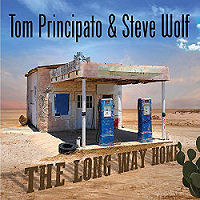
The Long Way Home
A Brand New CD Release From
Tom Principato & Steve Wolf
Read
about this title and
listen to soundbytes at the Powerhouse
Records Website.
Robert Johnson
Told Me So
Read
about this title and
listen to soundbytes at the Powerhouse
Records Website.
Tom Principato
uses and endorses…
• Fender
guitars and amps
• Seymour
Duncan pickups
• Curt
Mangan Strings
• Roger
Mayer effects
• Fulltone
effects
• SoundSeat
music seats
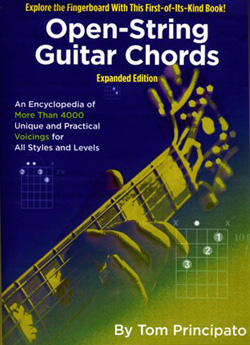
Check out Tom's Chord Book with
4,000 chord voicings. Guitarists will find it a valuable reference
whenever something special or different is needed...
|